When Service & Reliability Count
Give us a Call!
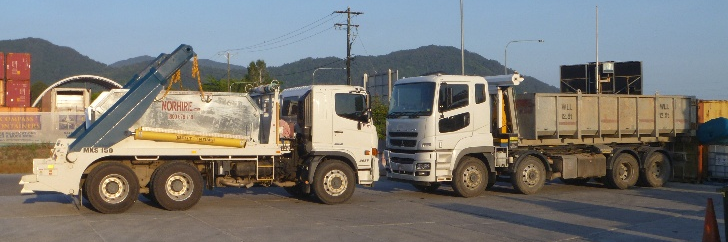
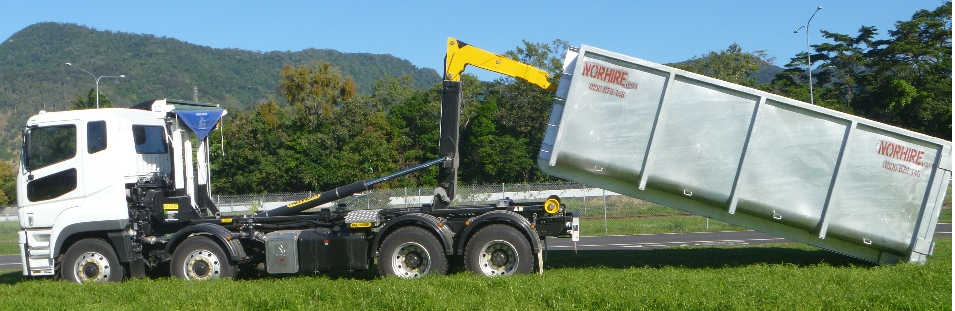
A hook bin is dragged onto the truck using a large ring located on the front of the bin and a single centrally mounted hook arm on the carrying vehicle, the loading arm in this case ends up under the bin when the bin is loaded. Hook bins are emptied the same as a tip truck – the back door opens completely, the front of the bin is hoisted up, and the contents slide out the back. Hook bins can therefore be as wide and long as the legal length of the carrying vehicle permits, so can have much greater volumes. Although hook bins can be found as small as 3 or 4 cubic metres, they are most commonly 10 – 20 cubic metres and are ideal for removing large volumes of material. They are usually of a very robust construction and are very common on demolition sites and large construction sites, but their large site footprint and the fact they are dragged onto the truck, potentially leaving drag marks behind means they are not often used for domestic clean-ups and such.
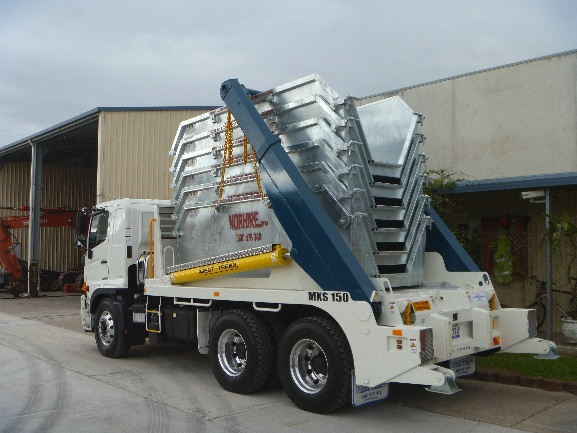
A skip bin is lifted vertically off the ground on chains suspended from a pair of lifting arms positioned on each side of the truck, the bin passes between the lift arms as it is loaded onto the truck. The skip bin is emptied in a reverse of the loading process but with one end of the bin fixed to the truck either by a leaver or chains. When being emptied the skip bin is basically turned upside down. The size of a skip bin is thus limited by the distance between the lifting arms and the length of the arms which themselves are limited by the dimensions of the truck and the fact that the bins essentially must be inverted to be emptied. So, skip bins are generally limited in size to a maximum of about 9 or 10 cubic metres. However, because of the way that skip bins are constructed they can be stacked for storage and transport. Skip bins for the most part are of a much lighter construction than hook bins. Skip bins are often used for domestic clean-ups and on smaller construction sites such as renovations and domestic house construction. Heavy duty skip bins with a very robust construction are often used in conjunction with heavy skip trucks to transport very dense material such as demo concrete, soil, and asphalt.
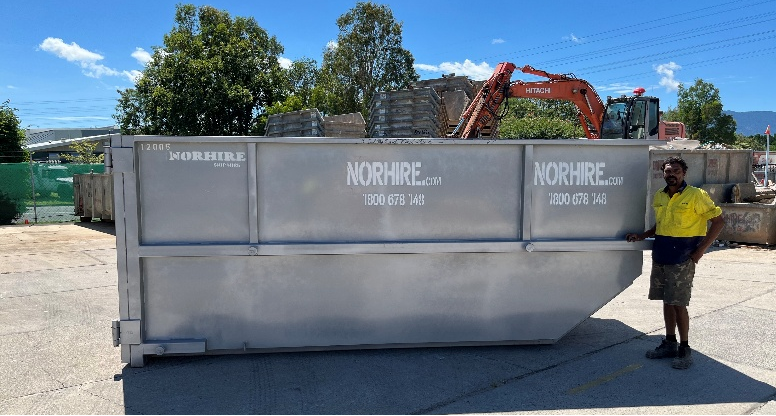
To confuse the situation however there are now skip bins called Barn Door Skip Bins. Barn door skip bins have a door at the back of the bin which can be folded completely open, leaving the entire back of the bin open, the same principle as a hook bin. Because the back of the barn door skip bin can be completely opened and the bin emptied in a similar manner to the hook bin it does not need to be turned upside down thus allowing the bin to be higher and longer than a normal skip bin. Barn door skip bins are usually in the size range 8-15 cubic metres. Barn door skip bins are often used where it is unsuitable to use a hook bin but compared to an equivalent size hook bin, they have much higher sides which makes them much more difficult to efficiently load