When Service & Reliability Count
Give us a Call!
Commercial Skip Bins & Recycling
At Norhire Commercial Skip Bins Hire & Recycling, we understand that efficient waste management is crucial for your business operations. Our comprehensive commercial services are designed to help you maintain compliance, reduce costs, and improve your environmental footprint, all while ensuring minimal disruption to your day-to-day activities. We’re here to make waste management simple, transparent, and cost-effective for your business!
Our goal is to support your business in achieving its sustainability goals while saving you time and money. With our reliable, customer-centric approach, you can focus on what you do best—running your business—while we efficiently handle your waste needs.
Understanding the various methods employed in pricing construction waste bins is essential for both service providers and customers. This webpage offers a comprehensive overview of the current practices, their advantages, and practical considerations.
There are three primary methods utilised in the pricing of commercial skip bins. These methods have evolved over time, influenced by regulatory changes and operational efficiencies.
This method was predominantly used prior to the implementation of the Waste Levy. It involves setting a predetermined price for the bin service, based on volume, with no regard to weight. With the advent of the Waste Levy, which necessitates the use of weighbridges at landfills, this approach has become less practical. While providing absolute certainty to customers regarding price, the bin provider is left with all the risk with regard to bin weight and disposal cost.
In response to the changed regulatory requirements, many service providers adopted a fixed price with a cut-off weight. This model involves charging a fixed fee for waste bins below a specified weight threshold, with additional charges applied for bins exceeding this limit. It requires minimal additional management effort, as record-keeping and invoicing are simplified. Customers benefit from predictable costs, which facilitate budgeting. However, the skip bin provider is relying on an averaging principle within the defined weight range to determine price, and as such is exposed to some risk with regard to disposal cost.
Regarded as the fairest, charges customers strictly based on the actual weight of waste disposed of in each bin. This method necessitates full access to a weighbridge and a robust management system to ensure accurate weighing and timely invoicing. It aligns costs directly with waste generation, encouraging waste minimisation and efficient waste management practices.
We advocate for the floating price model, which we term “TRUCK PLUS DUMP”.
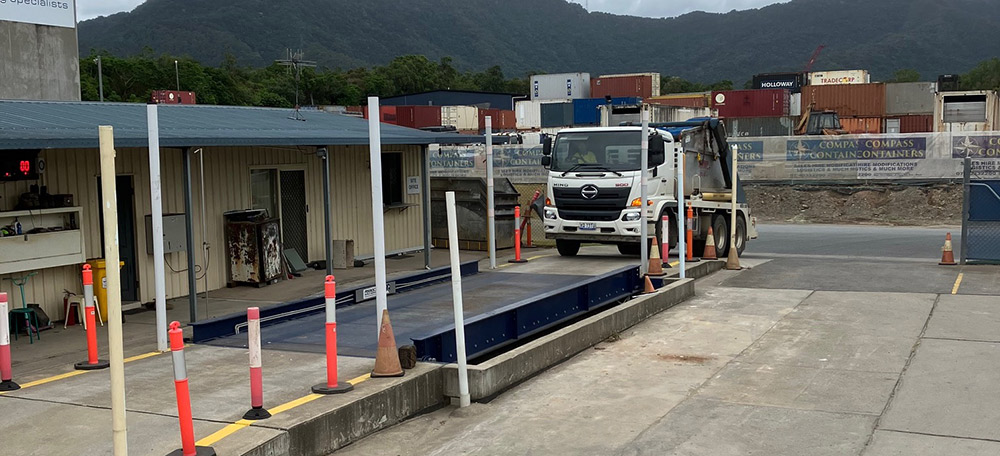
Our operation includes a registered and certified weighbridge, enabling precise measurement of each bin. Every pickup is weighed, and data is recorded and included on invoices, facilitating transparency and customer awareness. We also have a Waste Transfer and Recycling Station to process Mixed Builders Waste, and our pricing structure is based on the density of material, reflecting the fact that light material such as styrofoam, plastic wrapping and cardboard cost more to dispose of than concrete and other heavy material. The best way to demonstrate the relationship between bin weight and disposal cost is by using a graph.
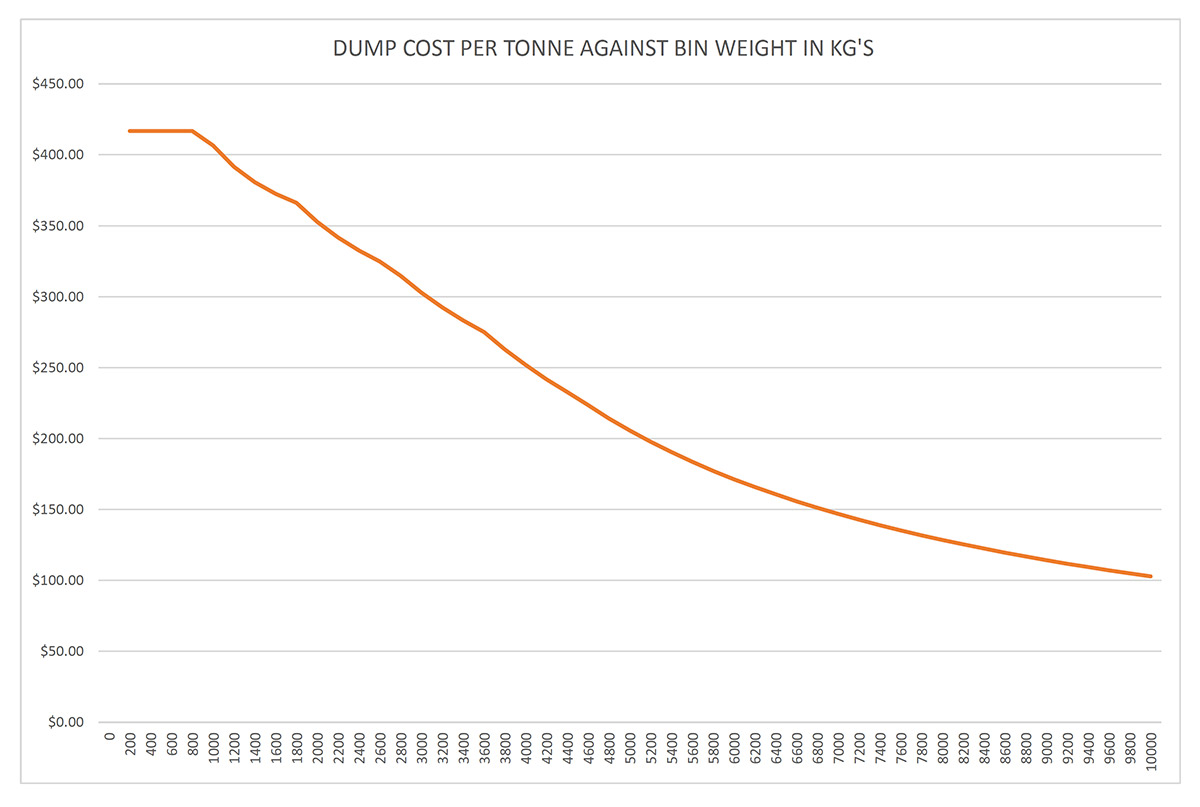
For example: The per tonne charge for a bin containing 1 tonne is about $400, while the per tonne charge for a bin containing 10 tonnes is about $100.
Many people don’t know what a typical mixed builders waste bin weighs and have difficulty comparing our method of bin pricing with a cut-off price method, so to exemplify the typical weights involved, we have analysed all our Mixed Builders Waste bins dumped over a three-month period (March-May 2025). A summation of that analysis compared to various cut-off weights appears in the following table.
| CUTOFF WEIGHT tonnes | 0.5 | 1 | 1.5 | 2 | 2.5 | 3 |
| AVERAGE WEIGHT OF BINS ABOVE CUTOFF tonnes | 1.89 | 2.29 | 2.95 | 3.60 | 4.20 | 4.68 |
| PERCENTAGE OF BINS ABOVE CUTOFF WEIGHT | 88.42% | 66.18% | 40.20% | 26.24% | 18.23% | 13.63% |
| AVERAGE WEIGHT OF BINS BELOW CUTOFF tonnes | 0.33 | 0.61 | 0.88 | 1.04 | 1.16 | 1.24 |
| PERCENTAGE OF BINS BELOW CUTOFF WEIGHT | 11.58% | 33.82% | 59.80% | 73.76% | 81.77% | 86.37% |
| OVERALL AVERAGE WEIGHT OF ALL BINS tonnes | 1.71 | 1.71 | 1.71 | 1.71 | 1.71 | 1.71 |
We believe that at any cut-off weight level, our system of progressive pricing combined with accurate weights and efficient sorting of waste compares favourably with all other methods of bin pricing.
Norhire is committed to providing transparent, fair, and efficient waste management solutions tailored to your needs.
For further details or to receive an indicative price list at various weight levels, please do not hesitate to contact us:
Email: gary@norhire.com.au
Phone: 07 4054 7344